Korean vs Japanese Skincare: Which Is Better for Indian Skin?
Korean glass skin or Japanese mochi skin? Two beauty philosophies, endless skincare products, but which one actually deserves a place on your shelf?
By Roopsee · · 10 min read
Korean glass skin or Japanese mochi skin? Two beauty philosophies, endless skincare products, but which one actually deserves a place on your shelf?
If you've been exploring skincare recently, you've probably noticed the growing popularity of Korean and Japanese beauty products.
From Korean centella serums and rice-based sunscreens to Japanese hydrating lotions and cleansing oils, both K-Beauty and J-Beauty offer interesting approaches to skincare.
But here's something important: just because a product is Korean or Japanese doesn't automatically mean it's right for your skin.
Your skin type, concerns, environment and the product's complete formulation matter much more than where it comes from.
Let's explore the differences between Korean and Japanese skincare, the ingredients they're known for, and how to choose suitable products in India.
What Is Korean Skincare (K-Beauty)?
K-Beauty refers to skincare products, routines and beauty practices originating in South Korea.
Korean skincare is widely associated with hydration, innovative formulations, lightweight layering and products designed around individual concerns.
Its popularity has grown alongside ingredients such as:
- Centella asiatica
- Snail mucin
- Niacinamide
- Rice extracts
- Hyaluronic acid
- Propolis
- Fermented ingredients
- Ceramides
What Is the Korean Glass Skin Trend?
Glass skin is a popular Korean beauty term describing skin that appears smooth, hydrated, luminous and naturally dewy.
Despite the name, glass skin doesn't mean having invisible pores or perfectly textureless skin.
Real skin naturally has pores, fine lines and texture.
The aim is to support hydration and skin health rather than chase an unrealistic complexion.
Explore Korean Skincare Products on Roopsee
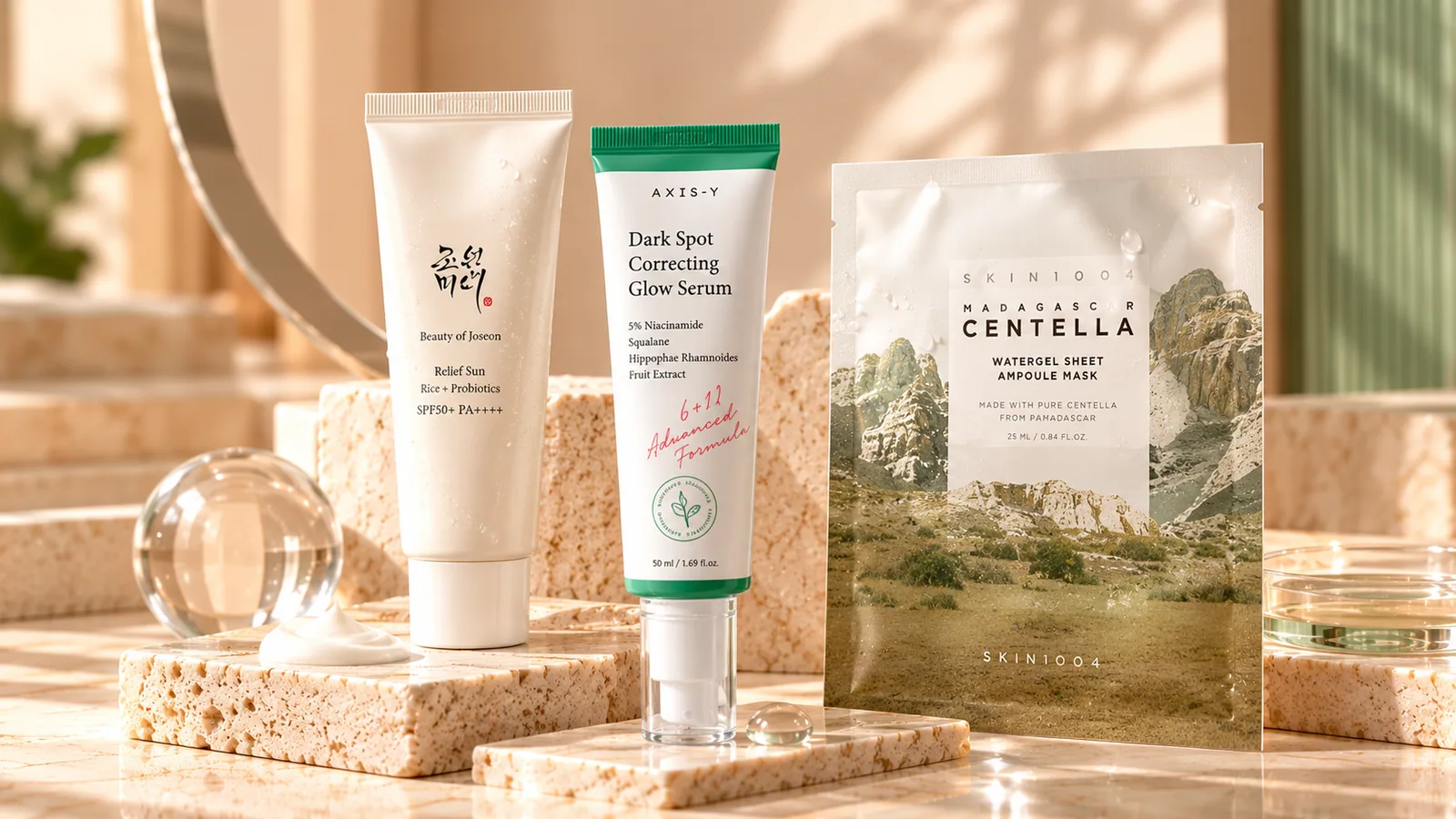
1. Beauty of Joseon Relief Sun: Rice + Probiotics SPF50+ PA++++
A Korean sunscreen featuring rice extract, niacinamide, UV filters and other supporting ingredients.
It is designed for daily sun protection while providing a comfortable skincare finish.
Explore Beauty of Joseon Relief Sun on Roopsee
2. AXIS-Y Dark Spot Correcting Glow Serum
This serum features 5% niacinamide, squalane and rice bran extract.
It may be worth considering for people exploring products for uneven skin tone and dark spots, depending on their skin's needs.
Explore AXIS-Y Dark Spot Correcting Glow Serum
3. SKIN1004 Madagascar Centella Watergel Sheet Ampoule Mask
This Korean skincare mask features centella asiatica extract, glycerin, panthenol and sodium hyaluronate.
These ingredients are commonly used in hydrating and skin-comfort formulations.
Explore SKIN1004 Centella Mask on Roopsee
Remember that even a gentle-looking Korean skincare product can cause irritation if it doesn't suit your skin.
What Is Japanese Skincare (J-Beauty)?
J-Beauty refers to skincare products and beauty practices originating in Japan.
Japanese skincare is often associated with simplicity, consistency, gentle cleansing and long-term skin maintenance.
Instead of focusing on the number of products in a routine, traditional J-Beauty approaches often emphasise using a few well-formulated products consistently.
Common ingredients found in Japanese skincare include:
- Rice bran extract
- Hyaluronic acid
- Camellia oil
- Green tea extract
- Ceramides
- Fermented rice ingredients
- Arbutin
What Is Japanese Mochi Skin?
Mochi skin is a beauty expression inspired by the soft, smooth and bouncy texture of Japanese mochi rice cakes.
It describes skin that looks supple, moisturised and healthy.
While Korean glass skin is often associated with a luminous finish, mochi skin places greater emphasis on softness and plumpness.
Neither beauty ideal is a medical measure of skin health.
Korean vs Japanese Skincare: Key Differences
Both beauty traditions value hydration and skin protection, but their popular routines are often presented differently.
| Feature | Korean Skincare | Japanese Skincare |
|---|---|---|
| Beauty philosophy | Personalisation and layered hydration | Simplicity and consistency |
| Popular skin aesthetic | Glass skin | Mochi skin |
| Routine approach | Flexible, sometimes multi-step | Often streamlined |
| Popular ingredients | Centella, snail mucin, niacinamide, propolis | Rice bran, green tea, camellia oil, hyaluronic acid |
| Common products | Essences, ampoules, serums, masks | Cleansing oils, lotions, emulsions, sunscreen |
| Hydration approach | Often uses lightweight layers | Often uses a few complementary products |
| Sunscreen | Important | Important |
| Best for | Depends on product and skin type | Depends on product and skin type |
These are general trends, not fixed rules. Many Korean brands make minimalist products, and Japanese brands also develop advanced, targeted skincare formulations.
Popular Korean Skincare Ingredients and Their Benefits
1. Centella Asiatica: For Skin Comfort
Centella asiatica, commonly called cica, is popular in products intended for skin comfort and barrier support.
It is found in many Korean toners, ampoules and creams.
It may be useful in a suitable routine for skin experiencing dryness or discomfort, although the complete product formulation remains important.
2. Snail Mucin: For Hydration
Snail secretion filtrate is used in some Korean skincare essences and moisturisers.
It is associated with moisturising and skin-conditioning benefits.
However, snail mucin is not essential for healthy skin, and evidence for some of its more ambitious anti-ageing claims remains limited.
3. Niacinamide: For Uneven Tone
Niacinamide is a form of vitamin B3 used in products targeting uneven skin tone, excess oiliness and barrier support.
It is a common ingredient in Korean serums.
4. Rice Extract: For Skin Conditioning
Rice-derived ingredients are widely used in East Asian skincare.
Depending on the formulation, they can contribute to hydration, skin conditioning and antioxidant support.
Korean products frequently combine rice-derived ingredients with other skincare actives.
Popular Japanese Skincare Ingredients and Their Benefits
1. Rice Bran: For Skin Conditioning
Rice bran contains lipids and antioxidant compounds, although the benefits of a finished product depend on how the ingredient is processed and formulated.
It is commonly associated with traditional Japanese skincare.
2. Hyaluronic Acid: For Hydration
Hyaluronic acid is a humectant that helps attract and retain moisture.
Japanese hydrating lotions frequently incorporate different hyaluronic acid formulations.
Despite its popularity in J-Beauty, hyaluronic acid is also found in Korean, Indian and other international skincare products.
3. Camellia Oil: For Emollient Care
Camellia oil is a traditional ingredient used in Japanese beauty routines.
It functions primarily as an emollient and can help soften the skin.
However, richer oil-based products may not feel comfortable for everyone, particularly those who prefer lighter textures.
4. Green Tea: For Antioxidant Support
Green tea-derived ingredients contain compounds known for antioxidant activity.
They are included in skincare products aimed at conditioning and protecting the skin.
Clinical benefits depend on ingredient concentration and product formulation.
Korean vs Japanese Skincare: Which Is Better for Indian Skin?
Indian skin is not a single skin type.
People in India have different levels of pigmentation, oil production, sensitivity and skin barrier needs.
The best approach depends on your individual skin profile and how a product performs in your daily environment.
For Oily and Acne-Prone Skin
Consider lightweight, non-comedogenic formulations.
A Korean niacinamide serum or a Japanese lightweight hydrating lotion might both fit your routine.
Choose based on formulation rather than country of origin.
For Dry and Dehydrated Skin
Both Korean and Japanese skincare offer hydrating products.
Look for ingredients such as glycerin, hyaluronic acid, ceramides and appropriate moisturising agents.
Layering several products isn't necessary if one suitable moisturiser provides adequate hydration.
For Sensitive Skin
Focus on gentle, well-tolerated formulations.
Avoid assuming that all centella products are suitable for sensitive skin or that Japanese products are automatically fragrance-free.
Check the complete ingredient list and introduce products gradually.
For Dark Spots and Pigmentation
Consider evidence-supported ingredients such as niacinamide, azelaic acid or appropriately formulated Vitamin C products.
Daily sun protection is important, particularly for pigmentation concerns.
Persistent melasma or dark spots may need professional evaluation.
For Humid Indian Weather
If your skin feels oily or uncomfortable in humidity, lightweight gels, lotions and fluid sunscreens may feel more pleasant.
But richer creams may still be appropriate for dry skin, even in warmer climates.
Is Korean Skincare Better Than Japanese Skincare for Glowing Skin?
Both can help support healthy-looking skin.
Korean skincare may appeal to someone who enjoys exploring essences, targeted serums and hydrating layers.
Japanese skincare may appeal to someone who prefers a compact routine built around cleansing, moisturising and sun protection.
However, neither approach is inherently better for glowing skin.
A consistent routine with suitable products generally matters more than following a specific country's beauty trend.
Can You Combine Korean and Japanese Skincare?
Absolutely.
You don't have to choose one philosophy exclusively.
For example, a simple morning routine could include:
- Gentle cleanser
- Hydrating lotion or serum
- Moisturiser, if needed
- Broad-spectrum SPF 30 or higher sunscreen
At night, you might use a cleansing oil when appropriate, followed by a gentle cleanser and moisturiser.
You can mix products from both countries as long as the formulations suit your skin and work together comfortably.
A ten-step skincare routine is not a requirement.
What to Check Before Buying Korean or Japanese Skincare in India
Before purchasing an imported skincare product, consider these five questions.
1. Does it suit your skin type?
A product designed for dry skin may feel too rich for someone who prefers lightweight moisturisers.
2. What are the key ingredients?
Look beyond product names and marketing claims.
3. Is the product authentic?
Choose a trustworthy seller and check the packaging, expiry details and other relevant product information.
4. Is the price reasonable?
Compare the selling price, quantity and value rather than relying only on the discount percentage.
5. Do you actually need it?
A trendy ampoule or essence is optional if your current skincare routine already addresses your needs.
Discover Korean Skincare Products on Roopsee
Choosing a Korean or Japanese skincare product shouldn't involve endless guessing.
With so many brands, ingredients and formulations available, it's important to understand which products are relevant to your skin.
Roopsee helps you explore skincare based on your skin type and concerns using personalised Skin Match scores.
From Korean sunscreens and serums to soothing masks, you can discover products and evaluate whether they're appropriate for your needs.
Explore the Roopsee skincare collection and discover your personalised matches.
Don't shop by skincare trends alone. Shop for your skin.
Frequently Asked Questions
1. Is Korean skincare better than Japanese skincare?
Neither is universally better. Korean skincare is often associated with layered hydration and innovative formulations, while Japanese skincare is commonly associated with simplicity and consistency. Individual product suitability matters more.
2. Is Korean skincare suitable for Indian skin?
Yes, Korean skincare products can suit Indian consumers, depending on their skin type, concerns, formulation and tolerance.
3. What is the difference between glass skin and mochi skin?
Glass skin describes a luminous, smooth-looking complexion, while mochi skin refers to a soft, supple and bouncy appearance. Both are cosmetic beauty ideals.
4. Which is better for oily skin: K-Beauty or J-Beauty?
Both offer lightweight skincare products. Choose non-comedogenic formulations suitable for oily skin rather than selecting products solely by their country of origin.
5. Do I need a 10-step Korean skincare routine?
No. A simple cleanser, moisturiser and sunscreen routine may be sufficient for many people, with additional treatments introduced according to individual needs.
6. Which Korean skincare ingredients are good for hydration?
Hyaluronic acid, glycerin, panthenol and other humectants are commonly found in hydrating Korean products.
7. Which Japanese skincare ingredients are popular?
Rice bran, camellia oil, green tea, hyaluronic acid and ceramides are commonly associated with Japanese skincare formulations.
8. Where can I explore Korean skincare products in India?
You can explore Korean skincare products, including products from Beauty of Joseon, AXIS-Y and SKIN1004, on Roopsee.com.
Final Thoughts: K-Beauty or J-Beauty?
Korean skincare and Japanese skincare each bring interesting approaches to everyday skincare.
K-Beauty is often associated with innovation, personalised layering and luminous skin.
J-Beauty is commonly associated with thoughtful formulations, consistency and a streamlined routine.
But the best skincare isn't determined by nationality.
It's determined by the ingredients, the complete formulation and how well the product suits your skin.
Your skin doesn't need every trend. It needs the right care.
Explore skincare and discover your Skin Match on Roopsee.com.
Disclaimer: This article is intended for general skincare education and does not replace professional medical advice. Consult a qualified dermatologist for persistent or worsening skin conditions.