Best Skincare Ingredients for Oily & Acne-Prone Skin in India
Your skin is oily by lunchtime, your pores seem constantly clogged, and just when one pimple disappears, another shows up. Sound familiar?
By Roopsee · · 10 min read
Your skin is oily by lunchtime, your pores seem constantly clogged, and just when one pimple disappears, another shows up. Sound familiar?
Finding the right skincare for oily and acne-prone skin can feel overwhelming, especially when every new serum promises clearer, smoother and glowing skin.
But here's something worth knowing: the most popular skincare ingredient isn't necessarily the right one for your skin.
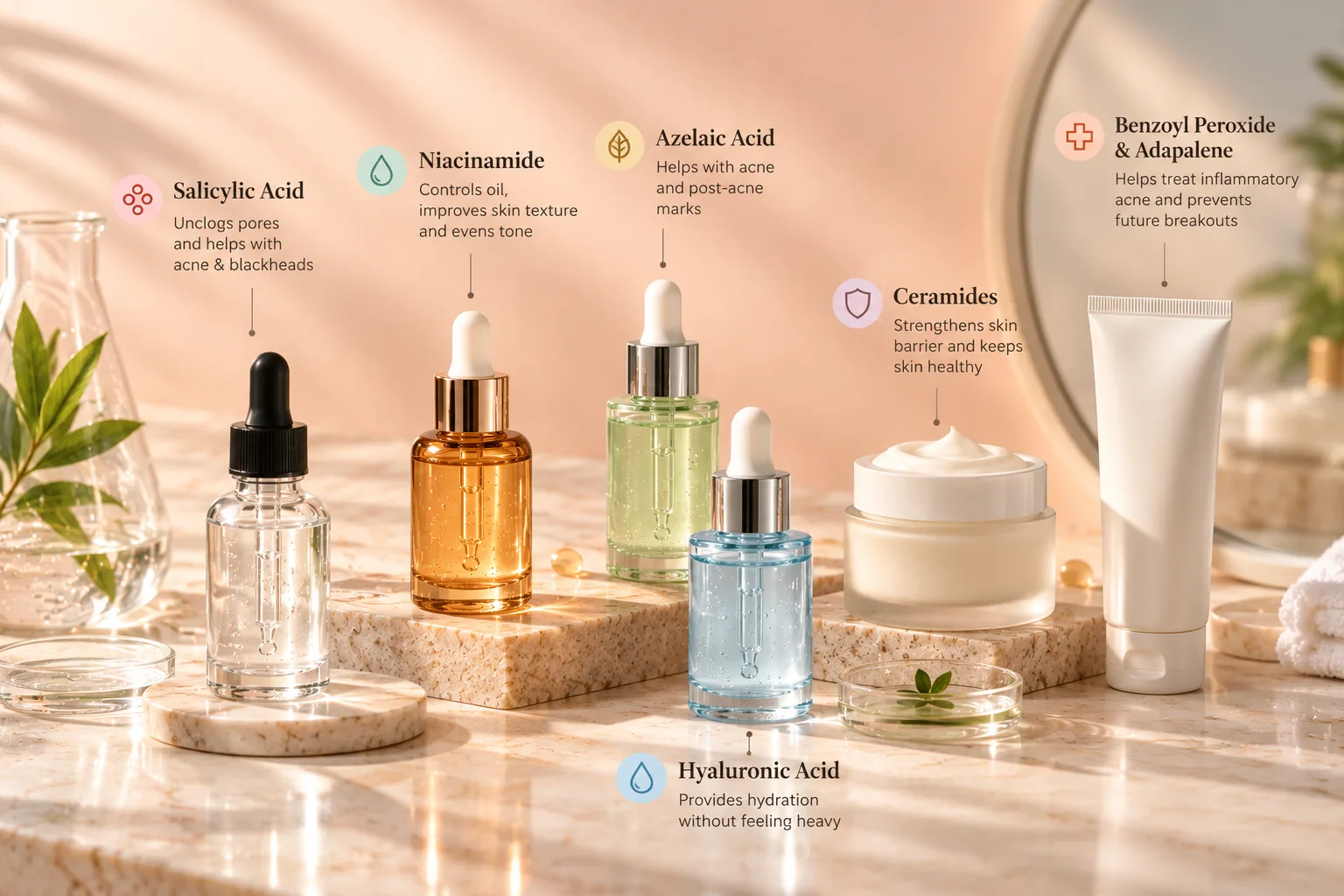
Salicylic acid, niacinamide, azelaic acid and other skincare ingredients all work differently. Understanding their benefits can help you choose products more confidently.
Whether you're dealing with excess oil, blackheads, frequent breakouts or acne marks, this guide explains seven ingredients worth knowing about.
Why Does Oily Skin Get Acne?
Your skin naturally produces sebum, an oily substance that helps protect and moisturise it.
However, excess sebum combined with dead skin cells can contribute to clogged pores.
Acne can develop when these blocked follicles become inflamed.
Several factors influence acne, including:
- Hormonal changes
- Genetic predisposition
- Excess sebum production
- Clogged hair follicles
- Inflammation
- Certain cosmetic products that may contribute to breakouts
Hot and humid weather may also make oily skin feel greasier. However, sweating and humidity do not automatically cause acne.
The goal isn't to remove every trace of oil from your face. It's to manage breakouts while maintaining a healthy skin barrier.
1. Salicylic Acid – For Blackheads and Clogged Pores
Salicylic acid is one of the most familiar skincare ingredients for oily and acne-prone skin.
It belongs to the beta-hydroxy acid (BHA) family and works by exfoliating dead skin cells and helping clear blocked pores.
Benefits of Salicylic Acid
- Helps reduce clogged pores
- Useful for blackheads and whiteheads
- Helps improve rough skin texture
- May improve certain types of mild acne
Best suited for: People experiencing oily skin, blackheads, whiteheads and congested pores.
Found in: Face washes, exfoliating serums, toners and acne treatments.
What to remember: Higher concentrations aren't automatically better. Frequent application can cause dryness, irritation and peeling.
If you're new to exfoliating acids, introduce salicylic acid gradually and follow the product's instructions.
2. Niacinamide – For Oil Balance and Skin Barrier Support
Niacinamide, a form of vitamin B3, is another widely used ingredient in products designed for oily skin.
Unlike salicylic acid, it doesn't exfoliate your skin.
Instead, it's commonly included in formulations intended to improve skin barrier function, uneven tone and the appearance of excess oil.
Benefits of Niacinamide
- Supports the skin's protective barrier
- May help regulate oiliness
- Can improve the appearance of uneven skin tone
- May reduce the appearance of certain dark spots
- Helps maintain skin hydration
Best suited for: People experiencing excess oiliness, uneven tone and skin barrier concerns.
Found in: Serums, moisturisers, toners and cleansers.
What to remember: A 10% niacinamide serum isn't necessarily better than a 5% formulation. Higher-strength formulas can irritate some skin types.
Related reading: Niacinamide vs Salicylic Acid: Which Is Better for Your Skin?
3. Azelaic Acid – For Acne and Post-Acne Marks
You know those stubborn brown marks that remain long after a pimple has healed?
They may be a form of post-inflammatory hyperpigmentation.
Azelaic acid is an ingredient used in dermatology for acne and certain pigmentation concerns.
It has anti-inflammatory properties and can also help improve acne-related dark marks.
Benefits of Azelaic Acid
- Helps manage certain forms of acne
- Has anti-inflammatory properties
- Can improve post-acne pigmentation
- Helps address clogged pores
Best suited for: People with acne and post-acne dark spots, depending on their skin's tolerance.
Found in: Dedicated acne treatments, creams and some skincare serums.
What to remember: Azelaic acid can still cause stinging or irritation, and stronger formulations may require medical guidance.
4. Benzoyl Peroxide – For Inflammatory Pimples
If your main concern is inflamed pimples rather than just oily skin, benzoyl peroxide is worth knowing about.
It's an established acne-treatment ingredient that works against acne-associated bacteria.
Benefits of Benzoyl Peroxide
- Reduces acne-associated bacteria
- Helps treat inflammatory acne
- Can reduce certain pimples and breakouts
Best suited for: People with mild inflammatory acne when appropriate for their skin and condition.
Found in: Acne-treatment gels, creams and cleansers.
What to remember: Benzoyl peroxide is an acne medication, not simply a cosmetic serum ingredient. It may cause dryness, irritation and fabric bleaching.
Seek professional advice before starting treatment when needed, particularly if you're pregnant, breastfeeding or treating a child.
5. Hyaluronic Acid – For Hydration Without Heavy Texture
Here's a common skincare misconception:
Oily skin doesn't need moisturiser.
Actually, oily skin can still become dehydrated.
Hyaluronic acid is a humectant that attracts and retains water, helping skin feel hydrated.
Benefits of Hyaluronic Acid
- Supports hydration
- Helps skin feel plumper
- Can reduce the uncomfortable feeling of dryness
- Works well in many lightweight skincare formulations
Best suited for: Oily or acne-prone skin experiencing dehydration, tightness or dryness.
Found in: Hydrating serums, gel moisturisers and lotions.
What to remember: Hyaluronic acid is not an acne treatment, and the overall product formulation matters more than the presence of a single ingredient.
6. Ceramides – For a Healthy Skin Barrier
If your skin feels tight, flaky or irritated after using an acne cleanser or exfoliating serum, your routine may be too harsh.
Ceramides are naturally occurring lipids that form an important part of the skin barrier.
They're commonly included in moisturisers to support the barrier and reduce moisture loss.
Benefits of Ceramides
- Help maintain the skin barrier
- Reduce moisture loss
- Support dry or irritated skin
- Can complement acne routines that cause dryness
Best suited for: Oily, acne-prone skin that is also dehydrated or experiencing barrier discomfort.
Found in: Moisturisers, barrier creams and hydrating lotions.
What to remember: Ceramides do not directly clear pimples, but a suitable moisturiser can help make an acne-treatment routine more tolerable.
7. Adapalene – For Blackheads, Whiteheads and Acne
Adapalene is a topical retinoid used in acne treatment.
It helps prevent clogged pores and can improve certain forms of acne over time.
Unlike ordinary cosmetic skincare ingredients, adapalene is a medicine and should be used with appropriate clinical guidance and in line with local prescribing requirements.
Benefits of Adapalene
- Helps prevent clogged pores
- Treats blackheads and whiteheads
- Helps improve inflammatory acne
- Can reduce future breakouts with continued appropriate use
Best suited for: People with acne who have been advised to use a topical retinoid.
What to remember: Adapalene may initially cause irritation, dryness or peeling. Retinoids should be avoided during pregnancy, and anyone planning pregnancy should seek medical advice.
Which Ingredient Is Best for Your Skin Concern?
Not all oily and acne-prone skin needs the same products.
| Your main skin concern | Ingredient worth considering |
|---|---|
| Excess oiliness | Niacinamide |
| Blackheads and whiteheads | Salicylic acid |
| Mild inflammatory pimples | Benzoyl peroxide |
| Acne with dark marks | Azelaic acid |
| Dehydrated oily skin | Hyaluronic acid |
| Irritated skin barrier | Ceramides |
| Persistent comedonal acne | Adapalene, with medical guidance |
These ingredients aren't interchangeable, and not every ingredient listed is an acne treatment.
Choose based on your main concern, skin sensitivity and current routine.
Simple Skincare Routine for Oily and Acne-Prone Skin
An effective routine doesn't have to involve ten products.
Morning Skincare Routine
Step 1: Gentle cleanser
Choose a cleanser that removes excess oil without leaving your skin feeling excessively tight or dry.
Step 2: Targeted serum, if needed
Consider niacinamide or another suitable ingredient based on your skin concern.
Step 3: Lightweight moisturiser
Look for a suitable non-comedogenic moisturiser that hydrates without feeling overly heavy.
Step 4: Sunscreen
Apply a broad-spectrum sunscreen with SPF 30 or higher. This is especially important if you're managing post-acne pigmentation.
Night Skincare Routine
Step 1: Cleanse gently.
Step 2: Use an appropriate acne treatment or skincare active if needed, following its directions.
Step 3: Moisturise to support the skin barrier.
Avoid introducing several strong active ingredients simultaneously.
Consistent use of a simple, suitable routine is often more useful than frequently switching products.
Common Skincare Mistakes to Avoid
Mistake 1: Using Too Many Active Ingredients
Using multiple exfoliating acids and acne treatments together without guidance can increase irritation.
Mistake 2: Skipping Moisturiser
Acne-prone skin still needs hydration. Dry, irritated skin can make treatment harder to tolerate.
Mistake 3: Buying Products Only Because They're Trending
A product that works for someone else may not suit your skin's needs.
Mistake 4: Expecting Overnight Results
Acne treatments typically require several weeks of consistent use before meaningful improvement becomes visible.
Mistake 5: Ignoring Persistent Acne
Deep, painful, scarring or persistent acne needs professional evaluation.
With Roopsee's Skin Match experience, you can explore skincare products based on your skin type and concerns, and review their personalised matching scores.
Salicylic Acid: Explore Products on Roopsee
If clogged pores, blackheads and excess oil are your primary concerns, you can explore the Chemist At Play 2% Salicylic Acid Face Wash, formulated with salicylic acid and additional supporting ingredients.
For those exploring a combination of niacinamide and salicylic acid, the Deconstruct Oil Control Serum contains both ingredients.
Always consider your skin's sensitivity before adding exfoliating products to your routine.
Niacinamide: Explore Products on Roopsee
Looking to introduce niacinamide into your skincare routine? Explore The Derma Co 10% Niacinamide Serum for a niacinamide-focused formulation.
If uneven tone and post-acne dark marks are additional concerns, you can also discover Deconstruct Dark Spot Clearing Serum with 5% Niacinamide and 2% Alpha Arbutin.
Remember, the percentage of niacinamide alone doesn't determine whether a serum is right for your skin.
Hyaluronic Acid: Explore Hydrating Serums
Oily skin can still need hydration. If your skin feels dehydrated, explore Deconstruct 2% Hyaluronic Acid Serum with 1% Niacinamide.
The combination is designed for hydration and skin comfort, though the overall formulation and your individual tolerance should guide your choice.
Ceramides: Explore Barrier-Supporting Moisturisers
A moisturiser can be an important part of an acne-prone skincare routine, especially when you're using exfoliating ingredients.
Explore Dot & Key Barrier Repair Intense Moisturizer with Ceramides, or discover Re'equil Ceramide & Hyaluronic Acid Moisturiser.
These moisturisers contain barrier-supporting and hydrating ingredients, but check their texture and formulation against your skin type before choosing.
Find Skincare That Matches Your Skin on Roopsee
Not sure which ingredients or products belong in your skincare routine?
Visit Roopsee to explore skincare products, discover your personalised Skin Match scores and make more informed shopping decisions.
Don't just follow skincare trends. Find products that match your skin.
Frequently Asked Questions
1. Which skincare ingredient is best for oily skin?
Niacinamide may help with oiliness, while salicylic acid is useful for clogged pores. The right choice depends on your main skin concern.
2. Is salicylic acid good for acne-prone skin?
Salicylic acid may help with blackheads, whiteheads and certain types of mild acne. It can cause irritation if overused.
3. Can oily skin use hyaluronic acid?
Yes. Oily skin can benefit from hydration. Lightweight hyaluronic acid formulations can help address dehydration without necessarily feeling heavy.
4. Which ingredient helps with acne marks?
Azelaic acid may help improve post-inflammatory dark spots left by acne. Sunscreen is also important for managing pigmentation.
5. Should acne-prone skin use moisturiser?
Yes. A suitable non-comedogenic moisturiser helps maintain hydration and may reduce dryness associated with acne treatments.
6. How can I find skincare suited to my skin?
Identify your skin type and key concerns, check the complete formulation and choose products suited to your needs. Roopsee's Skin Match tool can help you explore relevant skincare options.
Final Thoughts
Oily and acne-prone skin doesn't need every trending skincare ingredient.
Salicylic acid may help with blocked pores, niacinamide can support skin balance, and azelaic acid may be useful for acne-related marks.
Meanwhile, ingredients such as hyaluronic acid and ceramides help maintain hydration and barrier function.
The most effective approach is to identify your main concern and choose an appropriate product rather than adding more and more products to your routine.
Know your skin. Find your match. Shop smarter with Roopsee.
Visit roopsee.com to discover products matched to your skin.
Disclaimer: This article is for general educational purposes. It does not replace personalised medical advice, diagnosis or treatment. Consult a qualified dermatologist for persistent, severe or scarring acne, or before using acne medications when pregnant or planning pregnancy.